












Estonian building stock

LongEstWell data

Mobile data

State Individual e-Data

Population forecasts

IMO User Portal

Contextual data

Estonian building stock

Data from sensors and sensor networks enable monitoring of the environment, traffic flows and “smart cities”

LongEstWell data

Survey data collected during a long-term study of the well-being, behavior, and coping of the adult population.

Mobile data

Data obtained through passive and active mobile positioning, data collected using smartphones, and additional survey data

State Individual e-Data

1989, 2000, and 2011 data from population and housing censuses, national registries, and national surveys.

Population forecasts

Estimates of the future development of the population based on various data sources and models, which help to understand demographic changes and support long-term planning and decision-making.

IMO User Portal

The innovative and comprehensive data infrastructure supporting mobility research brings together a variety of data to better understand people's spatial mobility.

Contextual data

Other datasets needed to generate additional features for cellular or government data based or field specific research.

Partners

What is IMO?

There are many good social science databases in Estonia, but so far, they have not been longitudinally, geographically and on cross-domain bases harmonized and integrated. The IMO is the subject of the Estonian Research Infrastructures Roadmap, which aims to develop an innovative data infrastructure supporting mobile research, which consists of five main components: IMO single user Portal, country-specific e-data, mobile data, context data and sensor data. They are made available through secure workplaces, user interfaces, and query environments.

What is IMO?

The IMO wants to make the basic social science data more user-friendly, to bring it closer to decision-makers and to improve the quality of research.

Read more

Planned infrastructure

  • Continued development of the linked employee–employer dataset.
  • Linking Estonian and Finnish individual-level datasets to analyse cross-border migration flows.
  • Further development of data from the CV-Keskus job portal.
  • Linking individual-level data with the Estonian Biobank’s genetic data to study the relationships between heredity and socio-economic characteristics.
  • Interpretation, analysis and valorisation of big data collected by the urban environment sensor network.
  • Intensive use of the traffic flow video counting system and creation of additional datasets.
  • Integration of the traffic flow video counting system with the urban environment sensor network into a single integrated network for the continuous monitoring of traffic flow parameters in Tallinn, with later adaptation and development for other cities and regions.
  • IMO Services

    Population statistics on the basis of mobile phone data

    Population statistics on the basis of mobile phone data

    The map application uses passive mobile positioning data collected and processed by mobile operators in Estonia....

    Population statistics on the basis of mobile phone data

    The map application uses passive mobile positioning data collected and processed by mobile operators in Estonia. Passive mobile positioning data is location data that is automatically stored by mobile operators. The map application initially displays 2017 data; if possible, the time period will be extended. For a more detailed description of the data and methodology, see the reference to the (Passive Mobile Positioning Database). The map application allows viewing long-term population figures calculated on the basis of passive mobile positioning data at the level of different spatial units in Estonia. The application is intended primarily for public authorities, local authorities and other...

    Read more →
    Migration calculator

    Migration calculator

    The innovative migration calculator enables to assess the short and long-term effects of migration on the labor market...

    Migration calculator

    The innovative migration calculator enables to assess the short and long-term effects of migration on the labor market and of population development. Population projections are static, though updated from time to time. The migration calculator to be developed is a dynamic tool that allows for quickly and easily working through different labor market and migration as well as birth rate scenarios and predict their impact on the change of the working-age population. The migration calculator is based on a population projection but allows the user to easily and conveniently change birth and migration-related prerequisites. In the model, the following parameters can be changed: total birth rate...

    Read more →
    Population databases

    Population databases

    Harmonized data from the censuses (1989, 2000, and 2011) can be used in basic and applied research on a wide range of...

    Population databases

    Harmonized data from the censuses (1989, 2000, and 2011) can be used in basic and applied research on a wide range of topics. The database covers, for example, the following topics: household and family structures of the population (independence of young people, transformation of family models, different generations); spatial location; internal migration; profiles and integration of migrants (by origin, migratory generation, and life expectancy, etc.); linguistic demography (stability and exchange of the mother tongue, acquisition of the Estonian language, knowledge of foreign languages); housing conditions and their changes. By combining information on population events in the post-census...

    Read more →
    Analysis of the spatial location of people

    Analysis of the spatial location of people

    Passive mobile positioning data and detailed GPS data enable a variety of applied research and development of...

    Analysis of the spatial location of people

    Passive mobile positioning data and detailed GPS data enable a variety of applied research and development of methodologies on issues related to the spatial location and movement of people, including from short-term intraday movements to long-term changes. We offer research on foreign visitors based on passive mobile positioning data.

    Read more →
    Traffic flow analysis

    Traffic flow analysis

    Mobile traffic counting devices enable the operational measurement of various traffic flow characteristics and...

    Traffic flow analysis

    Mobile traffic counting devices enable the operational measurement of various traffic flow characteristics and parameters, which can be used to analyze the impact of traffic and transport on different areas.

    Read more →
    Impact of economic policy measures on entrepreneurial performance

    Impact of economic policy measures on entrepreneurial performance

    It is possible to use detailed company-level data and aggregate data of companies and employees to study various...

    Impact of economic policy measures on entrepreneurial performance

    It is possible to use detailed company-level data and aggregate data of companies and employees to study various economic policy measures (tax changes, subsidies). Examples of earlier research: Within the scope of the corporate income tax exemption study, the impact of the corporate income tax reform carried out in 2000 on the operational success of Estonian companies (liquidity, productivity, profitability) was investigated. See the project report here. In a study from 2019-2020 was examined the impact of enterprise support on companies’ export capacity, survival, innovative performance, productivity, and average wages. In the project “Effect of the minimum wage on the socio-economic...

    Read more →
    Factors of entrepreneurial performance

    Factors of entrepreneurial performance

    Factors of entrepreneurial performance: productivity, innovation, export It is possible to use detailed company-level...

    Factors of entrepreneurial performance

    Factors of entrepreneurial performance: productivity, innovation, export It is possible to use detailed company-level data and the aggregate data of companies and employees for various applied research on factors influencing entrepreneurial performance. Examples of past research: the relationship between export and starting of export with productivity, factors of innovative operation of companies, and their relationship to entrepreneurial performance. The research work of the IMO project has grown into the project “Industrial ecosystems and inter-firm relationships – Evidence from Estonia” (2022-2023) conducted with the OECD, where the role of customer and supplier relationships...

    Read more →
    Labor market research

    Labor market research

    Labor market surveys: employee mobility, wage factors, and wage inequalities It is possible to use detailed large-scale...

    Labor market research

    Labor market surveys: employee mobility, wage factors, and wage inequalities It is possible to use detailed large-scale data at the individual level as well as the aggregate data of companies and employees for various applied research. Examples of earlier studies include: different studies on factors influencing the gender pay gap in Estonia; studies of changes in the occupational and age structure of the workforce; studies on the impact of the economic crisis on the Estonian labor market. Examples from previous studies: EU H2020 project “InWeGe – Income, wealth, and gender. A study and practical web tool for understanding gender pay and pension gaps in Estonia – the country with the...

    Read more →
    Wave Dynamics Analysis

    Wave Dynamics Analysis

    Drift park with GPS support (design, deployment, tracking, data processing), remote telemetry data recording and...

    Wave Dynamics Analysis

    Drift park with GPS support (design, deployment, tracking, data processing), remote telemetry data recording and storage, web-based (or local) database for recording and storing geographic location data.

    Read more →

    Research

    The study of spatial development scenarios for Estonia’s National Spatial Plan (NSP) “Estonia 2050”

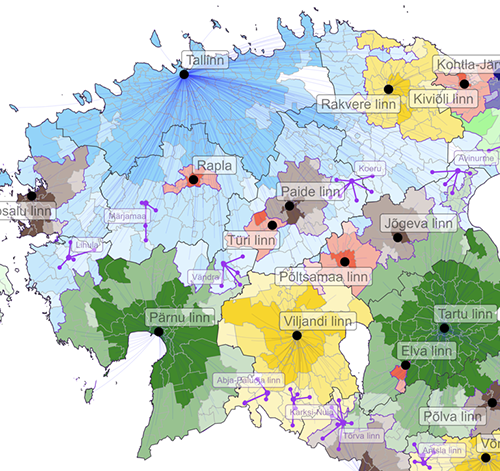
    The nationwide study on spatial development scenarios provides a scientific basis for guiding Estonia’s spatial development up to 2050. The study examines four possible development scenarios and shows that the current concentration of population and jobs in Tallinn exacerbates demographic and economic challenges in other parts of Estonia. Balanced development requires at least ten economically strong “locomotive” towns across the country, which would ensure better accessibility to jobs and services. Compact settlement development, curbing suburban sprawl, creating a high-quality living environment, and supporting the return of young people are considered crucial. More compact settlements help reduce environmental impact, travel costs, and public sector expenditures, while supporting sustainable and regionally balanced development in Estonia.

    EU Fund EU Fund
    Read more

    Infotechnological Mobility Observatory

    The research was conducted using the research infrastructure “Infotechnological Mobility Observatory” funded by the Estonian Research Council (TARISTU24-TK18)

    Beneficiary: University of Tartu

    Partners: Tallinn University of Technology, Tallinn University, Statistics Estonia

    Period: 2014 - 2029

    Brief description: Growing spatial mobility is one of the important changes in modern society, which is related to the topics of external and internal migration, urbanization, entrepreneurship, inequality and regional development. Up-to-date and high-quality data are needed to study spatial mobility. The goal of IMO is to develop an innovative data infrastructure supporting mobility research, integrating geographically and longitudinally diverse national statistics and innovative IT data sources.