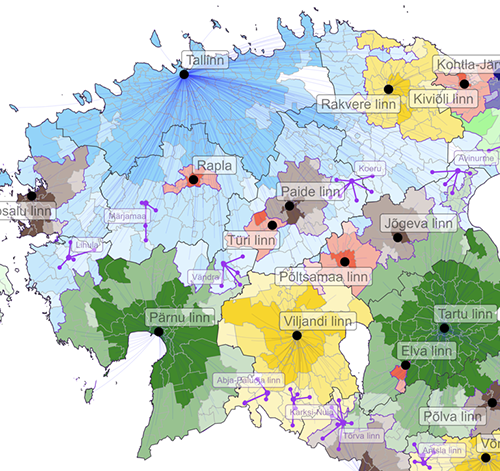
The nationwide study on spatial development scenarios provides a scientific basis for guiding Estonia’s spatial development up to 2050. The study examines four possible development scenarios and shows that the current concentration of population and jobs in Tallinn exacerbates demographic and economic challenges in other parts of Estonia. Balanced development requires at least ten economically strong “locomotive” towns across the country, which would ensure better accessibility to jobs and services. Compact settlement development, curbing suburban sprawl, creating a high-quality living environment, and supporting the return of young people are considered crucial. More compact settlements help reduce environmental impact, travel costs, and public sector expenditures, while supporting sustainable and regionally balanced development in Estonia.
Key messages of the study
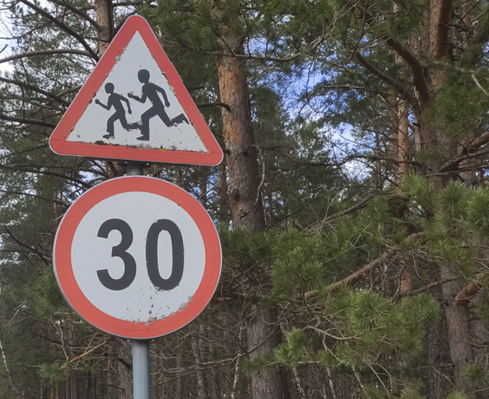
The current land-use pattern and the continuation of existing trends are neither sustainable nor regionally balanced. When preparing the nationwide spatial plan, it is necessary to consider alternative settlement development scenarios, along with their impacts and feasibility.
Balanced settlement development requires at least ten economically strong “locomotive” towns, evenly distributed across Estonia, which provide jobs and key higher-order services (such as tertiary education institutions and theaters) for both their own residents and those of surrounding areas.

A comparison of the four future settlement development scenarios shows that, alongside the capital region, the best path for the national economy is supported by the urban areas of Tartu, Pärnu, and Ida-Viru County, which make a significant contribution to Estonia’s competitiveness.
More balanced development is supported by a clearer regional division of roles: international, regional, and local cities, supported by smaller centers and rural areas.
Realizing young people’s residential preferences would result in a more even distribution of youth across Estonia in different living environments.
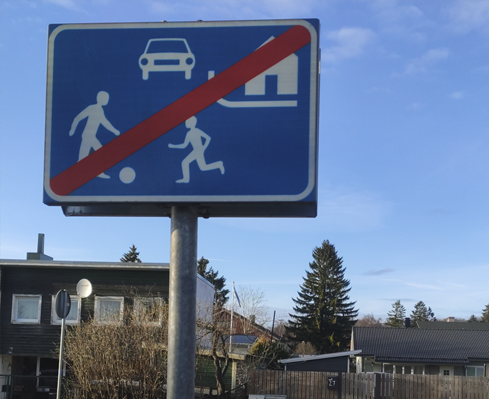
It is important to act as quickly as possible, because the greater the concentration of the population in the capital, the more difficult it becomes to ensure demographically and economically sustainable development in other regions of Estonia. Only Tallinn and Tartu have internal demographic recovery capacity. Most settlements in Estonia lack such capacity, and population growth can only be achieved through migration.
The most sustainable development path is spatially compact settlement, which helps ensure better connectivity with the locomotive towns, thereby improving access to both jobs and services across Estonia.
Growing and declining settlements require spatial interventions that support both their compact development and the creation of a high-quality living environment.
Research team
Core Team
Demographer: Tiit Tammaru
Human geographers: Anneli Kährik and Veiko Sepp
Architects: Andres Ojari and Toomas Tammis
Sociologist: Ann Ideon
Geoinformatics specialists: Anto Aasa, Kadi Kalm, and Jaanus Padrik
Spatial environment planners: Pille Metspalu and Ann Ideon
Additional Members
Architects: Raul Kalvo, Renee Puusepp
Mobility experts: Andres Sevtšuk, Frank Witlox
Demographer: Allan Puur
Human geographer: Kadri Leetmaa
Population and geoinformatics expert: Terje Trasberg
Regional development expert: Rivo Noorkõiv
Project co-lead: Kaidi Nõmmela
Expert Group
Economists: Tea Danilov and Uku Varblane
Sustainable development and climate policy experts: Helen Sooväli-Sepping and Antti Roose
Mobility expert: Age Poom